
The Just Live Lite application supports NDI®,SRT, UDP and ST-2110 based Playout including the ability to switch to a live source. Please note the following points when configuring a machine for streaming playout:
Realtime graphics are supported, but especially complex templates must be tested thoroughly before using them on air. This also applied to HTML graphics provided by third-party systems.
Currently we do not support mixed output methods (e.g., SDI In/Any IP Stream Out) as the selected output format also defines the live input source format.
Notes
Setting up a Channel for streaming out is as easy as setting up a Channel using an AJA or Blackmagic Design SDI out, using the Wizard or the Configuration window inside the Just Live Lite application.
When the “Switch to Live” function is activated, but no live stream is received, the Just Live Lite application tries to reconnect to the defined stream every few seconds. The interval will depend on the used streaming format (NDI®, SRT or UDP) - and when using SRT, if the Just Live Lite application is the Caller (~0,5 sec.) or the Listener (~3 sec).
Using NDI, the “Live Input” stream can be changed in the “Channel” tab of the Just Live Lite application while the channel is ON AIR. Using SRT or UDP, the Input stream has to be defined in the Streaming settings (“Configuration Panel→ Layers & Engines → Video → Configure Engines → Streaming”) and therefore cannot be changed while the Channel is running.
Additionally, when configuring a channel with NDI live input, there is a “NDI Timecode Mode” setting in the “Streaming” tab in the Just Live Lite configuration panel with the options “NDI UTC Timestamps” and “SMPTE Timecode”. The former expects frames with standard NDI UTC timestamps, as provided by the majority of NDI devices. The latter expects SMPTE timecode encoded as 100ths of a nanosecond. This may be useful in conjunction with some devices such as the AJA Bridge that takes embedded SDI SMPTE timecode and converts it for use with NDI.
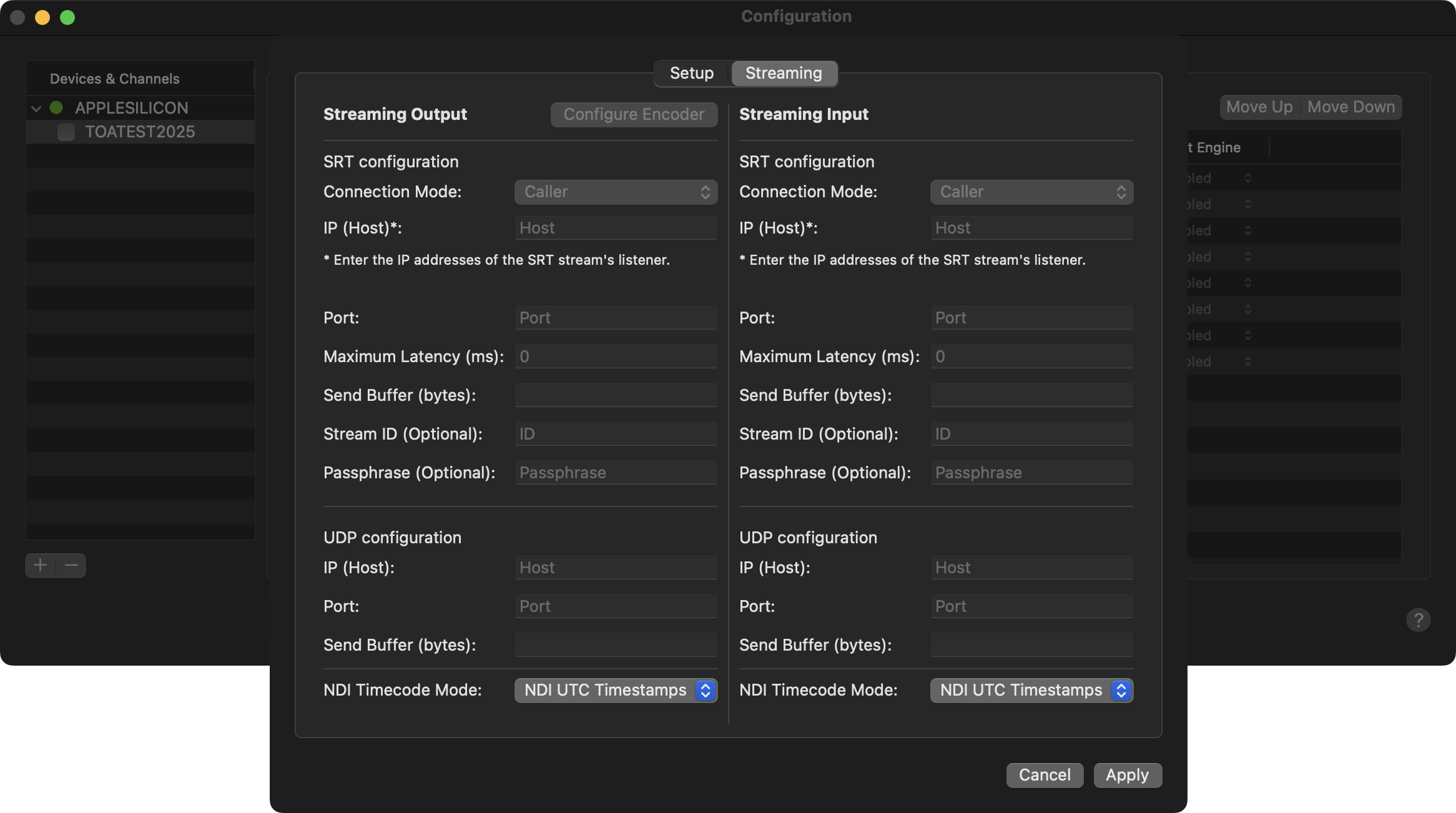
SRT and UDP streams support up to 16 audio tracks for the incoming and the outgoing stream.
Adjustable encoding parameters. When configuring the engine, there is a “Streaming” tab, which allows defining the IP Address/Port for the outgoing and for the incoming “Live” stream. Additionally, the H.264 profile/bitrate as well as the AAC audio bitrate can be defined for the outgoing SRT or UDP stream.
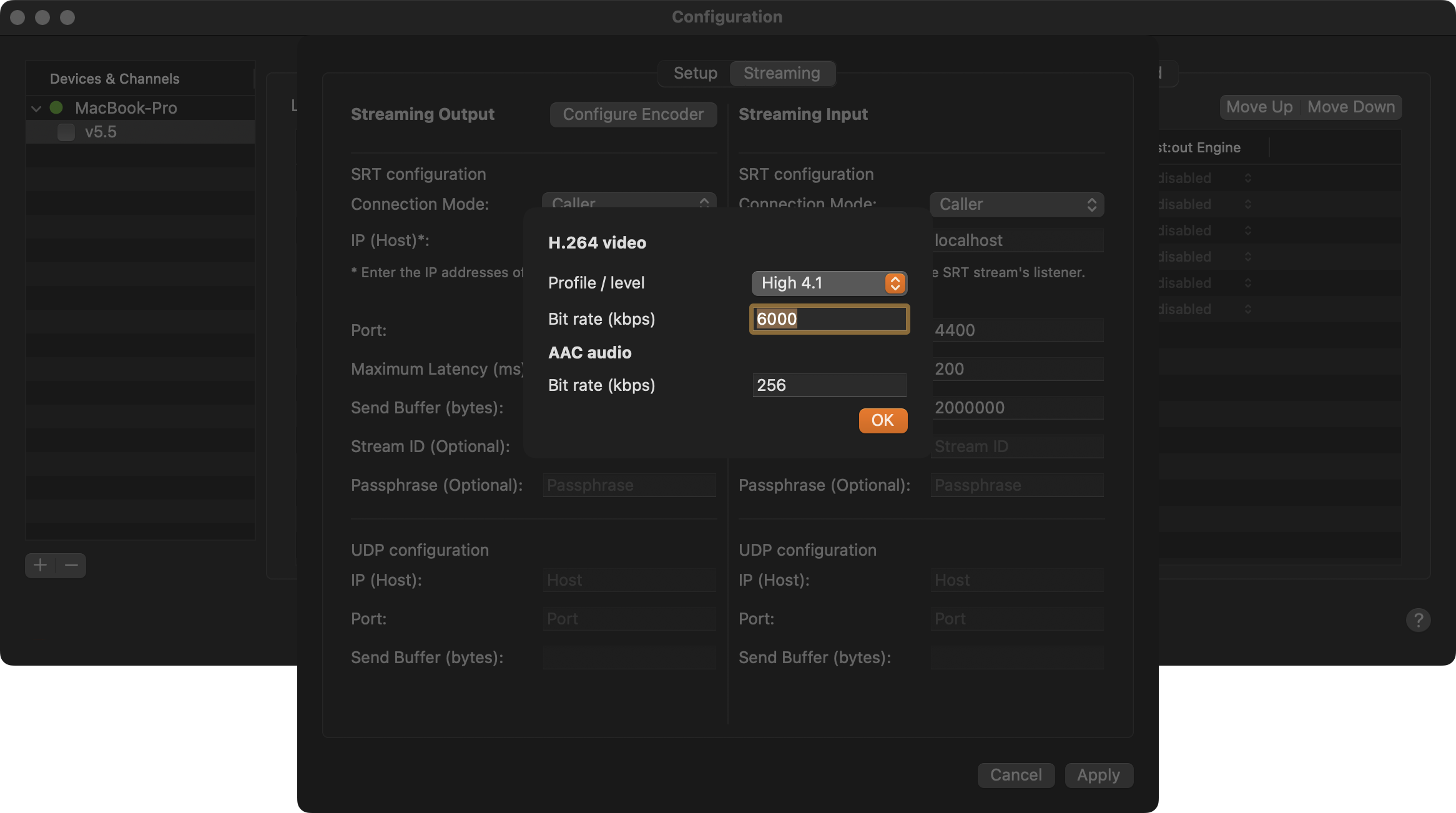
Supported “live” audio formats. Incoming SRT and UDP streams with MP2 (MPEG-1 Layer II) audio tracks in the MPEG transport stream are supported in addition to AAC encoded audio.
Limitations
The output stream is always progressive, as field-based movies are not currently deinterlaced. Therefore, for the best possible quality, please use progressive movies.
The incoming “Live signal” MUST match the Output Format defined for the Playout Channel.
Using SRT, we currently support “Caller” and “Listener mode”.
Using UDP, only Unicast connections are currently supported.
It is possible that there are no “Skipped Frames” shown in the Engine Diagnostic window, even there are skipped frames in the final stream.
NDI Fill & Key support will follow in an upcoming version.