
CORE I/O is a software-defined video platform that can be delivered as a ToolsOnAir turnkey appliance or installed on qualified customer hardware. This guide summarizes the supported deployment models, processing hardware, video inputs, codecs, wrappers, and IP transports. The exact channel count and available format combinations depend on the server, installed cards, licenses, and CORE I/O software version.
Deployment models
ToolsOnAir turnkey appliances
ToolsOnAir offers complete 1U and 2U turnkey systems based on Dell or TAROX servers, depending on the country of delivery. A typical appliance includes dual CPUs, redundant power supplies, redundant operating-system storage, internal HDD or SSD media storage, and two onboard 10 GbE interfaces.
Turnkey systems are normally supplied with three or five years of next-business-day support. The final support level, storage capacity, interface count, and optional cards are defined in the system quotation.
No vendor lock-in and customer-supplied hardware
CORE I/O has no server vendor lock-in. Customers may install the software on their own hardware, provided ToolsOnAir reviews and approves the complete configuration before installation begins. This qualification step confirms that the CPU, storage, network, PCIe layout, video interfaces, firmware, and operating-system configuration are suitable for the intended channel count and formats.
Core and processing nodes
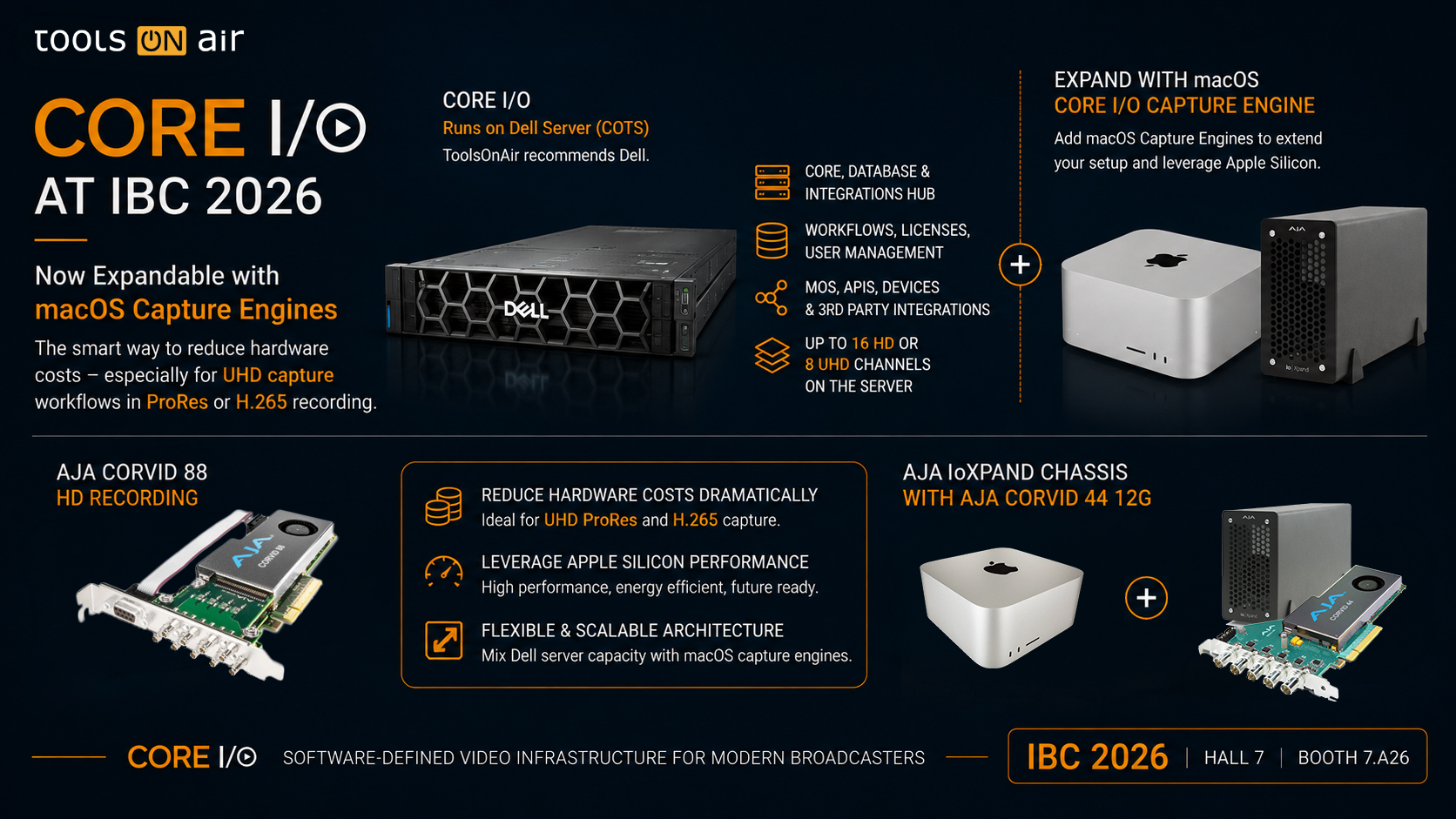
The central CORE I/O Core always runs on Linux. It can be installed on a qualified physical server or in a VMware virtual machine. The Core provides the database, user and license management, workflow coordination, APIs, device control, and third-party integrations.
Recording and playout capacity can be added as Linux processing nodes or as macOS Recording and Playout Nodes connected to the Linux Core. macOS nodes use Apple silicon and are particularly useful for scalable ProRes and H.265 workflows. This architecture lets one system combine centralized control with processing capacity distributed across server and macOS hardware.
Server and interface options
| Component | Supported configuration |
|---|---|
| Server chassis | 1U or 2U, normally with dual CPUs, redundant power supplies, redundant operating-system storage, internal HDD or SSD storage, and dual onboard 10 GbE. |
| Baseband video I/O | ToolsOnAir uses AJA Corvid cards exclusively for SDI video I/O, including AJA Corvid 44 12G and AJA Corvid 88 configurations. A standard turnkey configuration includes capacity for eight HD or four UHD/12G channels; larger qualified configurations can provide up to 16 HD or eight UHD channels. |
| Hardware codec acceleration | CORE I/O supports the Matrox M264 family for accelerated H.264 and H.265/HEVC processing. |
| SMPTE ST 2110 | AJA KONA IP and qualified Blackmagic Design 100G cards are supported for IP video workflows. |
| Storage connectivity | Internal HDD or SSD storage is supported. Fibre Channel connectivity is available as an option. |
| Network connectivity | Dual 10 GbE is standard on turnkey systems. Additional 1, 10, 25, or 100 GbE interfaces depend on the approved server and workflow. |
Supported input modes
| Format | Frame rates |
|---|---|
| UHD 2160p | 23.976, 24, 25, 29.97, 50, 59.94, and 60 fps |
| HD 1080p | 23.976, 24, 25, 29.97, 50, 59.94, and 60 fps |
| HD 1080i | 50 and 59.94 fields per second |
| HD 720p | 50 and 59.94 fps |
| SD 576i | 25 fps |
Capture sources
Depending on the installed hardware and licenses, CORE I/O can receive the following baseband and IP sources:
- SDI over 3G-SDI or 12G-SDI
- SRT
- NDI High Bandwidth
- RTMP
- RTP
- RTSP
- HLS
- MPEG transport streams
- SMPTE ST 2110 with optional IP video hardware
Video codecs
CORE I/O supports the following recording codecs and codec families. A codec may require a specific operating system, processing node, acceleration card, license, resolution, or wrapper.
- Apple ProRes 422, Proxy, LT, and HQ
- H.264
- H.265/HEVC on qualified hardware and macOS nodes
- Photo JPEG
- MPEG IMX 30, 40, and 50
- XDCAM EX, XDCAM HD, and XDCAM HD422
- XAVC-certified encoding, including XAVC Long GOP, XAVC-L/XDF01, XAVC Intra Class 100, XAVC 4K Long 4:2:2, and XAVC 4K Intra Class 300/480
- AVC-Intra 50 and 100
- AVC-ULTRA
- Avid DNxHD and Avid DNxHR
- Uncompressed 4:2:2
File wrappers
- MXF OP1a
- QuickTime
- MP4
- MPEG transport stream
- AVI
- Avid OP-Atom, available as an option
IP streaming profiles
IP workflows can use SRT, RTP, UDP, RTMP, RTSP, HLS, MPEG-TS, NDI High Bandwidth, and optional SMPTE ST 2110 connectivity. CORE I/O supports SRT version 1.5.6 or later and provides CBR, capped-variable-bit-rate, and variable-bit-rate encoding modes where the selected encoder supports them.
| Area | Supported values |
|---|---|
| Video | H.264 and H.265/HEVC, including real-time HD workflows up to 1080p50 or 1080p60 on qualified systems. |
| Profiles | Up to Main Level 5.1 and Main 4:2:2 10 Level 5.1, depending on the codec implementation. |
| Chroma and bit depth | 4:2:0 or 4:2:2 at 8-bit or 10-bit. |
| Audio | Up to 16 channels, arranged as eight stereo pairs, at 48 kHz. Supported streaming audio codecs include MPEG-2 and AAC-LC in MPEG-2 or MPEG-4 syntax. |
| Color | ITU-R BT.709, BT.2020, and HDR HLG according to ITU-R BT.2100. |
Audio, captions, and ancillary data
Qualified SDI workflows support embedded audio and Dolby E. CORE I/O can write captions and ancillary data, including OP-47, into supported MXF OP1a recordings. Availability depends on the selected video format, capture preset, audio mapping, and destination.
Optional components
Fibre Channel adapters, XAVC UHD support, Avid OP-Atom recording, SMPTE ST 2110 interfaces, additional network adapters, expanded storage, and extra processing nodes are optional. Ask ToolsOnAir to validate the complete workflow before ordering hardware or choosing a capture format.