
The Transcode Viewer monitors a flow that receives a stream and sends it through one or more encoders. It displays the preview, timecode source, and input and output connections. You can also use it to change the stream endpoint assigned to each node.
Add a Transcode Viewer to a dashboard (see Dashboards), then assign a Transcode flow.
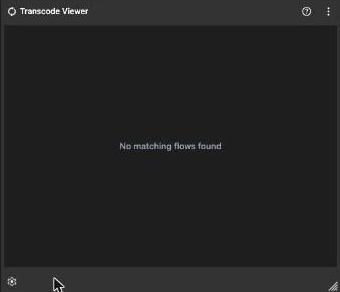
A Transcode Viewer before a flow is assigned
Layout
Header
The header contains the following controls:
- The transcode icon and flow name.
- The lock button. A locked viewer displays a large lock over the picture, ignores the endpoint hotkey, and disables the Endpoint menu item. Click the lock in either the picture or the header to unlock the viewer.
- The speaker button, which opens the Audio Monitor. Enable any of channels Ch01 through Ch16 to include it in the preview mix and unmute the widget. Closing the dialog mutes the preview again.
- The notifications icon, which changes to an error icon when the flow reports errors or warnings. Click it to open the flow's Errors and Warnings table. Click CLEAR to remove all entries, or CANCEL to close the dialog. Shift-click the icon, or select the viewer and press
Shift+W, to clear the entries without opening the dialog. - The flow nodes icon, which lists the flow's inputs and outputs. Each node shows its name or type and relevant details such as the encoder preset, streaming endpoint, or NDI source. An HLS output includes an Open link to its playlist.
- The ? button, which opens this chapter.
- The ⋮ settings menu.
Picture
The picture shows the flow's preview; without a signal the area reads No Signal. The widget frame is blue. A RUNNING badge sits at the bottom of the picture while there is a signal. Click the picture to select the viewer (orange frame); click again to deselect. Several Transcode Viewers can be selected at once.
Overlays
The overlays shrink as the widget gets smaller and disappear when there is no room.
| Overlay | What it shows |
|---|---|
| Timecode | A black box at the top with the stream's timecode. |
| Audio Meter | dBFS meters on the left and right edges, with eight bars on each side and marks at 0, -6, -12, -18, and -24 dB. The bars change from green to yellow and red toward the top. |
Footer
The footer holds the transcode status button. Click it to open the status tooltip:
- Timecode: The flow's Timecode Source.
- Input: The input label, node name, and endpoint name. Hover over the node or endpoint to view its type or address.
- Output: The output label and one line for each output node and endpoint.
If the server cannot return the status, the tooltip displays Error when get status.
Changing endpoints
Open the ⋮ menu and choose Endpoint, or select the viewer and press E. The Update Endpoints - <flow> dialog provides a selector for the input and for each output node.
A selection is applied immediately. If an update fails, the app displays Action update failed. Click DONE or CANCEL to close the dialog; Enter and Esc provide the same actions. If several Transcode Viewers are selected, the endpoint is applied to all of them. Define endpoints on the Stream Endpoints page.
Settings menu
| Entry | What it does |
|---|---|
| Endpoint | Opens the endpoint dialog. Unavailable while the viewer is locked. |
| Overlays | Submenu with Timecode and Audio Meter, each with On and Off. The choice is saved with the widget. If Record Viewers are selected, the change applies to them as well. |
| Remove Flow | Unlinks the flow from the widget. The widget goes back to its flow picker. |
Good to know
Selection matters for the E hotkey: it acts on the first selected Transcode Viewer.
While a Transcode Viewer is selected, Loop Viewers of other flows cannot be selected.
If the assigned flow is running another configuration type, the viewer remains inactive and identifies the required configuration. See Flows.